Turn2us annual impact 2025-2026
- Last reviewed 25 September 2026
Systems change for a fair economy
On this page
- Stigma in the system
- Research: a foundation for action
- Lived experience at the heart of influencing and campaigning
- Mobilising public support and working in coalition
Increasingly, Turn2us is investing in creating the conditions for lasting change, rather than only responding to crises. To us that means collective, coordinated, long-term action that tackles the root causes of the problems we see every day and works towards a fairer economy.
Financial insecurity is rarely only about what someone has coming in. How secure people feel, what savings and resources they can draw on, and whether they can absorb life's changes are all shaped by wider forces: rising living costs, insecure housing, and a lack of accessible, secure work.
Those pressures are produced by the systems around them. And the systems themselves rest on collective mindsets: the deep, often unconscious assumptions about how the world works and who deserves support.
Financial security for all cannot become a reality unless those root causes are addressed. This is long-term work, in which we will:
- draw on insights from people with lived experience of financial insecurity, alongside professional insights, published evidence and our own evaluation
- bring together decision makers, grant makers, the private sector and civil society in a broad coalition
- expand and deepen our partnerships with existing coalition partners
- foster greater engagement with social movements and grassroots networks
- use the data from tools like our Benefits Calculator to build actionable insights we can share with government
- use the successes from our work in local communities as evidence when seeking to influence policy and decision makers.

Stigma in the system
This year, we began challenging one of the most deep rooted barriers people face when seeking help: stigma.
Systems do not change through charities like Turn2us acting alone. Most of us deal with a bank, a pension provider or an insurer far more often than we deal with a charity.
So when trusted institutions like these speak positively about social security and encourage uptake, it plays a powerful role in normalising access to support and reducing stigma.
That is why our long-term partnership with Royal London, the UK's largest customer-owned life, pensions and investment company, matters to this work.
Since 2020, Turn2us and Royal London have worked together to ensure everyone has access to the tools and support they need when facing financial insecurity. Royal London backs our ambition to tackle financial insecurity at its roots by giving us the time, space and freedom to build strong foundations for lasting systems change.
Throughout the last year, with Royal London's commitment of £2 million running until 2028, we explored how, in partnership, we can:
- support more people to access financial support
- explore the role financial services companies can play in changing the conversation around benefits to focus on support, not stigma.
This has included exploring how to integrate Turn2us expertise into Royal London's customer journeys to support customers experiencing financial insecurity and make accessing support a seamless experience.
Our partnership with Turn2us is an important part of how we bring our Purpose to life, helping people build greater financial resilience. We're proud of how the partnership has grown, working together to make it easier for people to access the financial support they're entitled to and to challenge the stigma that can prevent people from seeking help. As a purpose-driven mutual, we want to use our scale and influence to make a positive difference, not just for our customers, but for wider society.
Stigma isn't abstract. It is part of the machinery of inequality: a powerful force that stops people accessing support which could protect them from financial insecurity.
Stigma around the social security system and those who use it makes it possible for politicians to enact deep cuts and tighten eligibility.
We have undertaken work to understand the complex ways that stigma around financial insecurity is produced and experienced within the UK social security system. Drawing on this insight, we are using our cross-organisational stigma programme to address this:
- within our own tools and programmes
- across the wider social systems we are part of.
Taking a systems perspective, we are investing in creating the conditions for a more compassionate and less stigmatising social security system. We're establishing long-term trusted partnerships with allies who share our theory of change, and together we're developing a new narrative around the role of social security.
Our movement is bringing together people with lived experience of financial insecurity, community-level organisations, academics and anti-poverty charities.
We're also broadening the movement by building relationships with organisations in other sectors, such as financial services institutions.
We're using empirical methods like message testing and communications framing, alongside storytelling, co-production and peer-to-peer learning, to collectively improve how we talk about social security.
Through this work we are also aiming to develop a new practice around policy, advocacy and campaigns - moving away from incrementalist wins towards deeper and more profound changemaking, grounded in the values of co-production, collaboration and collective accountability.
What stigma feels like
Alex left school at 15 and over 30 years built a career in marketing. But there are redundancies being made throughout this sector, and Alex has twice lost senior roles.
Ten years after his divorce, Alex shares the care of his children and contributes to the mortgage of the house where they live with his ex-wife, while covering his own rent.
The ongoing stress of financial precarity and debt damaged Alex's mental health, and he was treated for anxiety and depression. He applied for PIP but didn't hear back, and struggled to find out what benefits he could get.
When you are struggling with anxiety and depression … navigating the system is very difficult.
Alex found out that he was entitled to Universal Credit, though the first payment was £50 less than his rent.
When he contacted the DWP about this he found the responses cold and unhelpful.
He has been unable to receive child benefit and help with council tax and has found the Jobcentre unhelpful.
This included a difficult experience of job coaching when he was first unemployed - the Jobcentre saying they couldn't really help with his kind of work. Alex feels that the support system wasn't geared to meet the needs of a senior professional.
I was constantly treated with suspicion.
After a short-lived marketing sales position, Alex got a job as a postman with the Royal Mail. With a Universal Credit top up, his total income is about double his rent. He applied for hundreds of marketing roles to no avail, all the while slipping further into debt.
Eventually, he found freelance work through a former colleague, registered as a sole trader and now freelances to augment his Royal Mail income. But, he says:
I am deeper in debt and financial trouble than I would have been if I had gotten advice about setting up freelance work from the beginning… I am now energised at the prospect of building a new business, but I should have had this support from the start.
Research: a foundation for action
In September 2025 we published our landmark research, Stigma in the system: Experiences of the UK social security system.
Funded by Royal London, the research was carried out by the University of Bristol's Personal Finance Research Centre.
Its findings lay bare what it feels like to access the social security system today. This research represents a significant step forward: a robust evidence base that can shape national policy and unlock long term systemic change.
For many, the system designed to offer security instead creates fear.
I do feel like your life is in somebody else's hands… I know they can stop the money at any stage… I just hate it.
This wasn't an isolated story. Nearly two-thirds of participants said it feels like the system is trying to catch them out. Almost half said it makes them feel undeserving of support.
Shame and fear lead people to delay or avoid claiming altogether, even when they're eligible. Some wait months or years, cutting back on essentials or going into debt instead.
And for those who do apply, the process can take a toll - 51% of participants told us applying for benefits damaged their mental health, rising to nearly two‑thirds among people claiming disability benefits. One person living with fibromyalgia put it plainly: "Any stress will make it worse."
But there is hope. The public overwhelmingly believes that claiming support shouldn't be shameful, and would encourage a loved one to apply if they needed help.
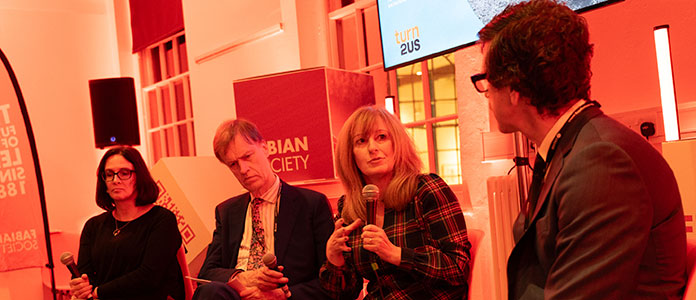
We launched this research at the Labour Party Conference in September 2025, with an event hosted in partnership with the Fabian Society called Social Insecurity: How to restore trust in the system. Over 80 people attended, hearing presentations and discussion, with a panel comprising:
- Kath Sangster (Chair) - Director of Scottish Fabians
- Sir Stephen Timms MP - Minister for Social Security and Disability
- Sara Davies - University of Bristol, who presented the research
- Tom Lawson - Turn2us Chief Executive
- Jo - Turn2us co-production partner.
Jo gave a well-received video presentation about her difficult interactions with the DWP since 2010, after experiencing serious health problems. She recounted how, after an emergency hospital admission:
"I didn't have any way of contacting the DWP to do anything about my Universal Credit, but I knew that I was coming up to the time when I had to report my earnings."
Jo asked a colleague to pass on the information to the DWP:
"…and she did it quite appropriately … and they refused to engage with her. And … then I was sanctioned. My claim was delayed and I eventually got it reinstated. But there was that period where not only was I dealing with the stress of going into hospital … but I was then having to do something that shows how inflexible the system was because it couldn't accept some information to prevent that sanction happening in the first place."
Jo concluded with a plea for a more humane system:
"If I was trying to think of one improvement I would like to see, it would be that the system that we're all trying to engage with could be more compassionate and treat us as the human beings we are, not just the number or the claimant."
Lived experience at the heart of influencing and campaigning
Building on this research, we developed policy recommendations and started a campaign.
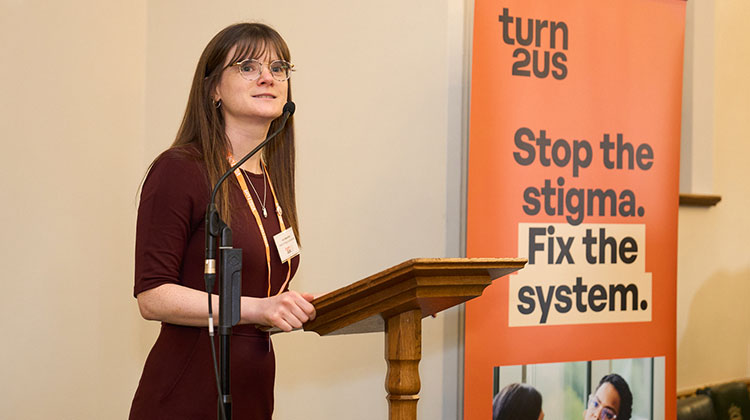
Stop the Stigma. Fix the System isn't a traditional campaign. It's been driven forward by a campaign group, made up of five co-production partners working with five Turn2us members of staff.
They've shaped the messaging, the policy asks, the events and the strategic direction. We're lobbying government to make three critical changes:
- Transform access to disability benefits - simplify the process of applying for PIP and training assessors so they understand the realities of disability and illness
- Supportive conversations, not interrogations - make sure frontline staff have the time and tools to build trust with the people they support
- Jobcentres that lead with trust, not suspicion - give people time and support to prepare for the next step in their career, instead of threatening sanctions that just don't work.
We launched Stop the Stigma. Fix the System in parliament in October 2025. Terry Jermy, Labour MP for South West Norfolk, sponsored the event, which was attended by Steve Darling MP, Liberal Democrat spokesperson for Social Security and several sector partners.
The launch enabled us to put our insights directly to the Department for Work and Pensions (DWP), with Andrew Western MP, Minister for Transformation, speaking at the event in response to our recommendations.
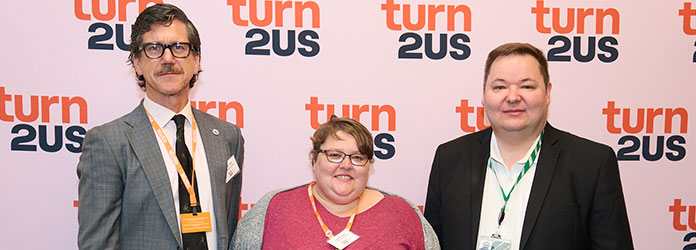
Three co-production partners attended the launch, including Caroline, who spoke about her experience of applying for Personal Independence Payment (PIP), then transferring to Adult Disability Payment (ADP) when moving to Scotland.
"I was made homeless, lost my job, and got signed off [sick] in the same week. I was put in temporary accommodation and recommended to apply for PIP. I filled out the form, I went to my assessment, and at my assessment, my assessor didn't even look at me. She … just spent the entire time typing."
A few weeks after the assessment Caroline was told she was not eligible for PIP.
A mandatory reconsideration agreed. So, Caroline took her case to a tribunal:
"I started a PIP application in January. In December I went to tribunal … the assessor said I had got it but then said: ‘by the way, you're only given it for a year, so you have to reapply in 3 weeks.'"
This was incorrect, but Caroline had to engage in further action:
"It took 18 months before it all finally shook out. That's 18 months where all my credit cards, because I was unemployed, all defaulted. Everyone who lent me money, who I had told it would only be a couple of months, it ended up being a year … and it took six years to properly recover from it."
Caroline's experience in Scotland was different.
"The ADP process is not perfect and I was only transferring, I wasn't applying as a new claimant, but I could call up Social Security Scotland to get the form filled out. They arranged a three-hour video call with a member of their staff … they filled out the form, they handed it in. Eight weeks later I got the results."
The ADP assessor asked Caroline how she performed domestic tasks like washing up. This meant that the interview captured the practical complexities of living with health problems in a way that yes/no questions never could.
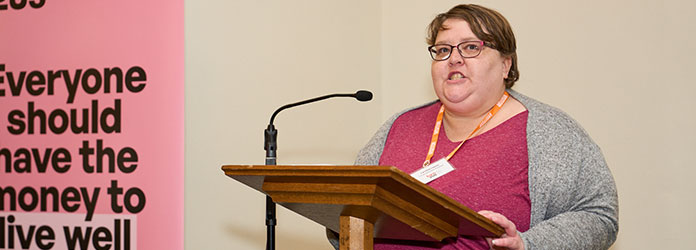
Feedback from MPs and sector partners was unequivocal: hearing directly from people with lived experience was the most impactful part of the event.
Since launching the campaign, we have built relationships with MPs, and civil servants have attended our sessions to hear directly from people with lived experience.
This is what early stage systems change looks like: more voices at the table, more pressure on decision makers, and clearer pathways to reform.
Mobilising public support and strengthening our influence
This year, we improved our digital campaigning, making it easier for people to stand with us on issues they're passionate about.
- 3,003 people have contacted their MP
- 2,454 people signed our open letter to the Secretary of State for Work and Pensions, Pat McFadden, calling for him to make sure our social security system always treats everyone with dignity and respect
- 3,184 people opted into our campaigning community.
Working in coalition to prevent harmful cuts
In March 2025 the government announced welfare reforms, including cuts to disability and sickness benefits, that would have had devastating consequences for many of the people we're here for.
We worked as part of a sector wide coalition, alongside organisations including Trussell, the anti-poverty and food bank charity, to challenge these proposals.
Our role was clear:
- bring lived experience into the heart of the conversation
- provide evidence from our research
- build relationships with MPs who could influence the vote.
Alicia is a Turn2us co-production partner with firsthand experience of navigating the social security system and campaigning to change it. She was involved in co-producing our PIP Helper tool and has shared her story of experiencing stigma in the media.
In November 2024 Alicia took part in a meeting with Ministers Sir Stephen Timms MP and Andrew Western MP to discuss reform of PIP. Speaking about this, she says:
"There was a point in the meeting where I looked around the room … and I said, am I the only person in this room who's ever claimed a disability benefit? And I was. I'm like, how can we be having this conversation about disability benefits without the people affected in the room. And that moment has driven me through a lot of stuff since then."
When the proposed government cuts were announced the following March, Alicia was part of the campaign to resist them. In June, she shared her story on ITV's Good Morning Britain, explaining how PIP enables her to pay for support that in turn enables independence:
"If I didn't have my PIP I'd be using all my energy just to survive … I currently work part-time … I would not be able to do that … PIP allows me to work."

The coalition's resistance, of which Alicia's story sharing was a part, was successful. We wrote a series of letters in August 2025 and February 2026 to the Minister for Disability and Social Security and the Co-Chairs of the Timms Review, calling for co-production that centred power sharing, transparency and robust evaluation.
These letters were signed by over 50 Disabled people, charities and Disabled people's organisations. The letters were welcomed by the Steering Group for the Timms Review and led to further engagement.
Download our full annual impact 2025-2026 report
Tell us the problem
*Required
Thank you
Thank you for your feedback.